

Crosta Mollica has taken its premium pizza proposition into the number two market slot in the UK over the last 18 months, largely based on its Made in Italy, authentic ingredients credentials.
In an interview with Just Food’s Simon Harvey, executive chairman David Milner says Crosta Mollica has moved up from being ranked fifth a year-and-a-half ago (based on market data), helped by a recent packaging rebrand and marketing campaigns.

Discover B2B Marketing That Performs
Combine business intelligence and editorial excellence to reach engaged professionals across 36 leading media platforms.
Pizza is the largest revenue-generating contingent (about 80%) among the London-based company’s range, which also features pasta, Italian flatbreads, amaretti biscuits and Italian desserts.
The former CEO of St Pierre bakery group, Lily’s Kitchen pet food and Tyrrells crisps suggests the premium pizza category is now “growing significantly” as Crosta Mollica pursues the “objective to be Europe’s most exciting pizza company”.
Simon Harvey (SH): How does Crosta Molicca pizza stand out from the crowd in a crowded aisle?
David Milner (DM): Most pizzas are all about how much you can sell on deal, so they’ll be priced at four pounds but sold at two pounds and that’s not a game we play.
Our pizzas are made in Italy by Italians, so they’re authentically Italian, they’re made of Italian ingredients. We’re not interested in playing in the promotional price game or the value game. We just want to make the best pizzas we can.
They are more expensive but I’ve always believed that people are prepared to pay a little bit more for something that’s better. One of our pizzas is shared between two people and they’re six pounds, so it may be a premium pizza but it’s not an expensive meal.
SH: There’s still talk that people aren’t eating out as much as they did but are willing to spend a bit more to replicate the out-of-home dining experience in the home.
DM: Maybe in the past a lot of people might have gone out or maybe had a pizza delivered but delivered pizzas can be £14-15 ($18.90-20.25). People don’t necessarily go out as much, or don’t have a takeaway as much but they spend a bit more on a supermarket pizza. It might be £6 but it’s still much cheaper than going out.
SH: I guess if the pizzas are made in Italy, Crosta Mollica uses a co-manufacturer?
DM: Everything that Crosta Mollica makes is made in Italy. It’s the whole point of the brand. We’ve gone to Italy to find the very best that they have to offer and bring it back to the UK.
I’ve been in the food industry for more than 40 years and there are some advantages to having your own factory. A lot of factories have been built some time ago and they’re very good at making something that was very posh, very fashionable in the 90s but it’s not anymore.
In many ways, it means you can adapt more quickly because you don’t have to build a factory. Since Covid, building factories is a nightmare, it takes about two years from start to finish, and we’re all on such short time scales these days.
I don’t want to be in that game where you have an idea, come up with the money, then spend two years building the factory, and then you hope it works. You can get it really wrong. Who would want to be in the middle of a factory build and then the market turns?
We spend our time trying to find out what people are looking for and certainly in food, people don’t want ultra-processed. They want clean label, provenance, authenticity and they want something exciting and new.
SH: Do you think moving away from ultra-processed foods is a long-term trend with legs in the context of the decline in the meat-free category, for instance?
DM: I think it has already had an impact but not with everybody. I think if you’re on a tight budget, you’ve got other concerns, to be honest. But I think people who are discerning and have the money to spend, they definitely are looking at the ingredients.
One of the issues with it is, there’s not a very good definition of ultra-processed but people mostly know if there aren’t many ingredients, and you recognise them, then you’re probably okay.
We make some breads which have four ingredients, and I don’t advertise them at all, I don’t push them at all, and they’re about 50% up year on year. That’s because people have spotted them, and then they do TikTok videos saying you should buy this because it only has four ingredients. I think it absolutely is here to stay.
SH: Is the UK your largest market?
DM: Yes, 80% of all our sales are into the UK, 20% into Europe. For the time being, we’re focused on Europe, we’re not looking any further afield than that.
SH: What are the major challenges Crosta Mollica is facing at the moment?
DM: Food inflation is still a challenge because whilst we’ve had lots of it at an unprecedented level, ingredients costs are still going up. It’s not one or two things. Olive oil has, to be fair, started to go back down, but most things are not looking good.
The issues with the Ukraine war are still relevant – a lot of sunflower oil is produced there, a lot of wheat is produced there.
People costs have gone up in the last UK budget – the minimum wage and national insurance. Ultimately, the higher costs have to be passed on to consumers.
SH: Do you see opportunities for consolidation in general and M&A from Crosta Mollica’s perspective?
DM: That’s not the plan here. Sometimes, when you make an acquisition it’s to buy the manufacturing capability and capacity. We don’t have that issue. I’m a great believer that if you’re building a valuable business, it’s about one brand. I don’t subscribe to the ‘let’s have a portfolio of brands or a stable of brands’.
So, no, M&A is absolutely not on my horizon. Our business grew about 40% last year so I don’t need to acquire for growth.
SH: When you talk about growth, is it all about innovation or is it expanding into new categories for Crosta Mollica?
DM: It’s definitely a combination of growth, of distribution. At first, we didn’t have any chilled pizza in Tesco. If you’re in a market like the UK and you haven’t got anything in Tesco then get something in Tesco, they’re the biggest retailer.
Then we look to innovate – we ask ourselves: ‘what is it that we could add to our portfolio which would incrementally grow our business’? Garlic bread is sold in the supermarket right next to pizza, so we’ve launched our brand into garlic bread. The good news about that is, it isn’t stealing from my own pizzas, it’s stealing from our competitor’s garlic bread.
There’s all sorts of pizzeria ideas from Italy that don’t make their way over here, so we’re launching those as well.
Then all of that is underpinned by the development of the brand. I would bet that three years ago, most people wouldn’t have heard of the Crosta Mollica brand, and now it’s quite different. Our tracking of brand awareness, trial, average spend are all very much in a positive trend.
SH: Is Crosta Mollica putting a lot behind marketing given the TV adverts out there?
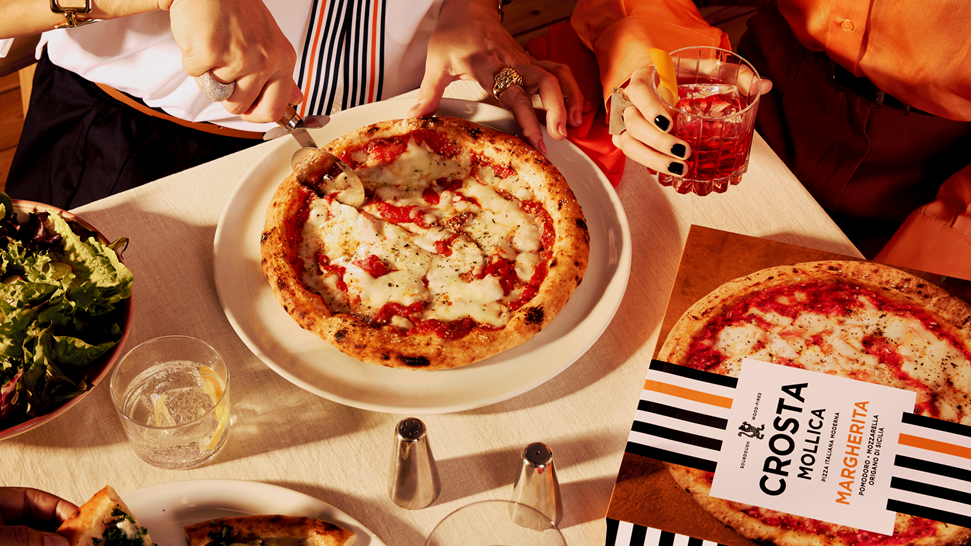
DM: We relaunched the look of the brand, which we did in February this year, we redesigned the look completely. It’s made in Italy so we wanted it to look as Italian as we could. We asked ourselves: ‘what would an Italian food brand do’? They’d sponsor the local football team.
So in Venice, not far from our factory, there’s a ladies team called Venezia and we are their shirt sponsors. We invite our supermarket buyers out to Venice to watch the matches, and we use it in all our social media.
SH: How is the gluten-free segment growing in your range? And your sourdough-based pizzas sound an interesting proposition, too.
DM: Gluten-free is not growing, it’s not very big and we do one pizza which is gluten free and it does okay.
You can’t really have a premium pizza unless it’s sourdough. It’s a ticket to play in the game. You have to be sourdough, otherwise you’re not premium.


